
Newsletter Subscribe
Enter your email address below and subscribe to our newsletter

 ByJohn A
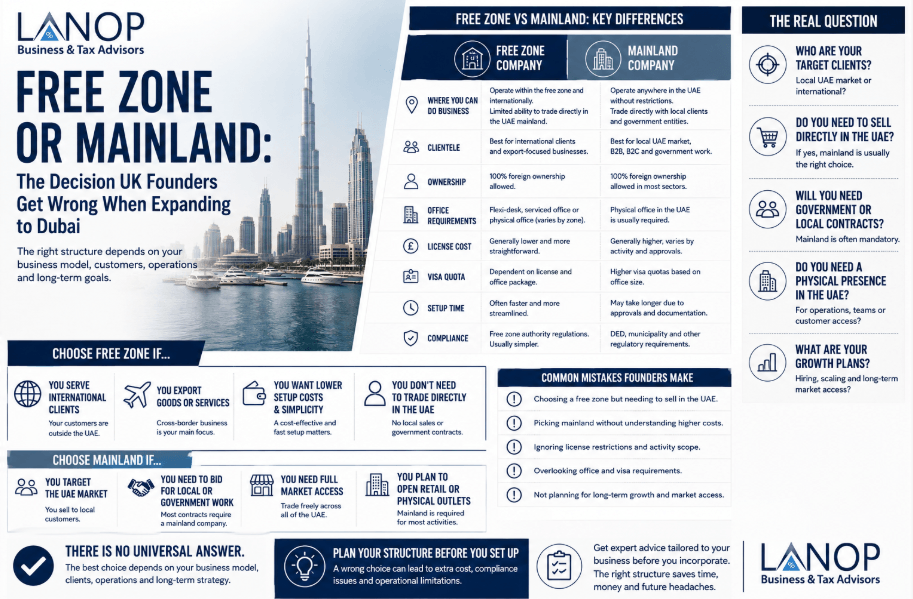
Most people who start business in Dubai from the UK hit the same wall in week one: a Free Zone or a Mainland licence, pick one. It sounds simple. It isn’t. The cheapest option on the price list rarely turns out to be the right one once you factor in where your customers are, what your business does day to day, and whether you already run a company back home.
Here’s the mistake we see constantly. Founders choose the jurisdiction first and figure out the business model afterwards. That’s backwards. Get the structure wrong and you’re not just stuck with an awkward licence, you’re looking at a costly rebuild eighteen months later, right when the business is finally gaining traction.
This article won’t tell you Free Zone is better, or that Mainland wins by default. It walks through the questions that decide the answer for your specific business.
Where and how will your business operate day to day? Start there instead.
Before you touch an incorporation form, work through five things:
A cheap licence can still be the wrong one. The advertised setup fee rarely includes renewal costs, visa allowances, banking friction, or what it costs to restructure later if your first choice stops fitting.
| Factor | Free Zone | Mainland |
| Foreign ownership | Generally 100% | Generally 100% |
| UAE market access | Activity-dependent | Broader, direct |
| Office setup | Flexi-desk options | Usually physical office |
| Corporate Tax | 0% if a Qualifying Free Zone Person | Standard 9% above threshold |
| Best suited to | International services | Local trade, UAE-facing sales |
Neither column wins by default. A consultant working entirely with British clients has almost nothing in common, structurally, with an e-commerce brand selling to Dubai households or a firm chasing government contracts. Treating them the same way is how founders end up with a licence that doesn’t match their business.
A handful of mistakes come up again and again, and they’re rarely the founder’s fault. This is exactly the information most formation agents skip over.
This is where a lot of generic advice falls apart, because most people trying to start a business in Dubai from the UK already run something back home. Incorporating in Dubai isn’t automatically your next move just because you’ve decided to expand.
You’ve got four realistic routes: keep trading through the UK Ltd for now, set up a UAE subsidiary owned by it, open a branch instead, or build a standalone UAE company with no ownership link back home. Each one changes how profits flow, how intercompany transactions get taxed, and what your accounting looks like across both jurisdictions.
The real question isn’t “should I open a Dubai company?” It’s whether you’re creating something new or simply relocating part of what you’ve already built.
Customer location shapes the decision more than almost anything else. A UK founder serving mostly British clients often has more flexibility than the marketing suggests. An internationally focused service business may lean naturally towards a Free Zone. Selling to UAE businesses or consumers is different, and so is opening a shop, restaurant, or warehouse; both tend to point towards Mainland, or at least towards additional approvals. Government contracts add another layer on top, since tender requirements often decide which structure qualifies at all.
Dubai isn’t the tax-free jurisdiction it used to be marketed as. UAE Corporate Tax now applies broadly. 0% is available only on the first slice of profit, and for qualifying Free Zone income that meets strict conditions. VAT may also apply depending on turnover and activity.
A Dubai company doesn’t automatically clear your UK tax obligations either. Your UK residence, where the company is managed day to day, and how profits move between the two countries all still matter, whether you relocate personally or stay put.
The headline licence fee is rarely the real number. Year one usually includes:
Compare the total cost of ownership across all five, not the incorporation fee alone.
Before you choose a jurisdiction, answer these:
Can I start a business in Dubai while living in the UK?
Yes. Company ownership and personal residency are separate, and plenty of founders run their UAE company remotely.
Is a Dubai Free Zone company really tax-free?
Not automatically. Only qualifying income for a Qualifying Free Zone Person gets taxed at 0%; everything else falls under standard UAE Corporate Tax rules.
Can I switch from Free Zone to Mainland later?
Usually, yes. It can mean new approvals and costs, so it’s worth planning for growth from day one rather than reworking everything down the line.
Should my UK company own my Dubai company?
It often makes sense if you want profits, management and reporting linked back to the UK entity. But it’s not the only option, and the right structure depends on how you plan to grow and eventually exit.
Do I need a local sponsor to set up a Mainland company in Dubai?
Not for most activities anymore, since full foreign ownership now covers the vast majority of Mainland business activities. A small number of regulated sectors still carry specific local shareholding requirements.
See also: Artificial Intelligence in Hospital Administration
There’s no universal winner between Free Zone and Mainland. The right structure depends on your customers, your business activity, your existing UK setup, and where you plan to be in three years, not on which licence looked cheapest in a search result. Sort those answers out first and the jurisdiction choice gets a lot easier. Skip that step, and you’ll likely pay to fix it later. Lanop Business and Tax Advisors can help you work through it properly before you incorporate anything.
